Language & Culture
Since 2014 Burundi has three official languages: Kirundi, French and English. By the same law on languages promulgated in 2014 Kiswahili is mentioned as a fourth language spoken and taught in the country. Of these, only Kirundi is spoken by the vast majority of the population. It is recognised as the national language by the Burundian constitution of 2005.
Burundi is unusual among African states in having a single indigenous language shared by its entire population. In one estimate, 98 percent of Burundians speak Kirundi. Under Belgian colonial rule (1919–62), Kirundi was taught whereas under German rule (1894–1916) Swahili had been encouraged.In recent years, the Burundian government has promoted the use of Kirundi language as way to unify the country’s different ethnic groups.
The country is considered part of Francophonie. As a legacy of Belgian colonial rule, French has an important role in government, business, and the educated classes but only between 3 and 10 percent of the population speak the language fluently. Burundian vernacular French also frequently incorporates loanwords from Kirundi, Lingala and other languages. French is spoken by a significant minority and is spoken mainly as a second language, as a French pidgin, or by foreign residents of the country. English was adopted as part of moves towards regional integration with the East African Community after 2007 but has little effective presence in the country.
Spoken languages in Burundi include Swahili which is widely spoken in the Great Lakes region. It is especially used in commerce and in connection with the country’s Muslim minority or with immigration from elsewhere in East Africa.
Burundi’s culture is based on local tradition and the influence of neighbouring countries, though cultural prominence has been hindered by civil unrest. Since farming is the main industry, a typical Burundian meal consists of sweet potatoes, corn, Rice and peas. Due to the expense, meat is eaten only a few times per month.
When several Burundians of close acquaintance meet for a gathering they drink impeke, a beer, together from a large container to symbolise unity.
Notable Burundians include the footballer Mohammed Tchité and singer Jean-Pierre Nimbona, popularly known as Kidumu (who is based in Nairobi, Kenya).
Crafts are an important art form in Burundi and are attractive gifts to many tourists. Basket weaving is a popular craft for local artisans. Other crafts such as masks, shields, statues and pottery are made in Burundi.
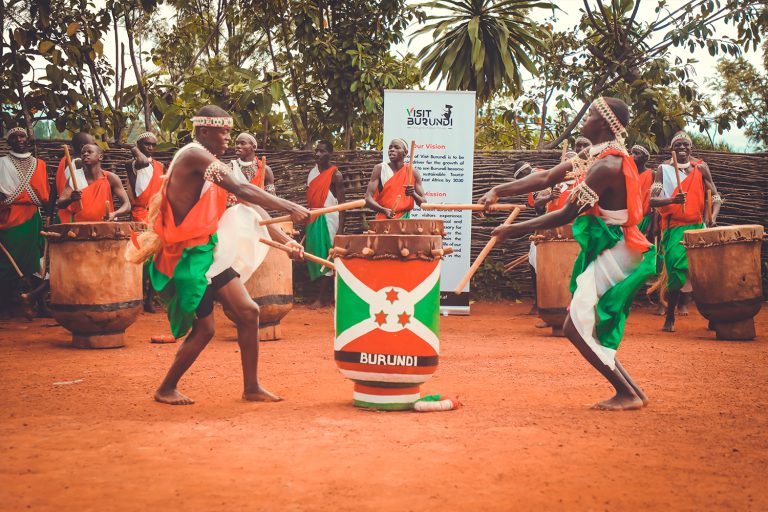
Drumming is an important part of the cultural heritage. The world-famous Royal Drummers of Burundi, who have performed for over 40 years, are noted for traditional drumming using the karyenda, amashako, ibishikiso and ikiranya drums. Dance often accompanies drumming performance, which is frequently seen in celebrations and family gatherings. The abatimbo, which is performed at official ceremonies and rituals and the fast-paced abanyagasimbo are some famous Burundian dances. Some musical instruments of note are the flute, zither, ikembe, indonongo, umuduri, inanga and the inyagara.
The country’s oral tradition is strong, relaying history and life lessons through storytelling, poetry and song. Imigani, indirimbo, amazina and ivyivugo are literary genres in Burundi.
Basketball and track and field are noted sports. Martial arts are popular, as well. There are five major judo clubs: Club Judo de l’Entente Sportive, in Downtown, and four others throughout the city.
Most Christian holidays are celebrated, with Christmas being the largest. Burundian Independence Day is celebrated annually on 1 July. In 2005, the Burundian government declared Eid al-Fitr, an Islamic holiday, to be a public holiday.