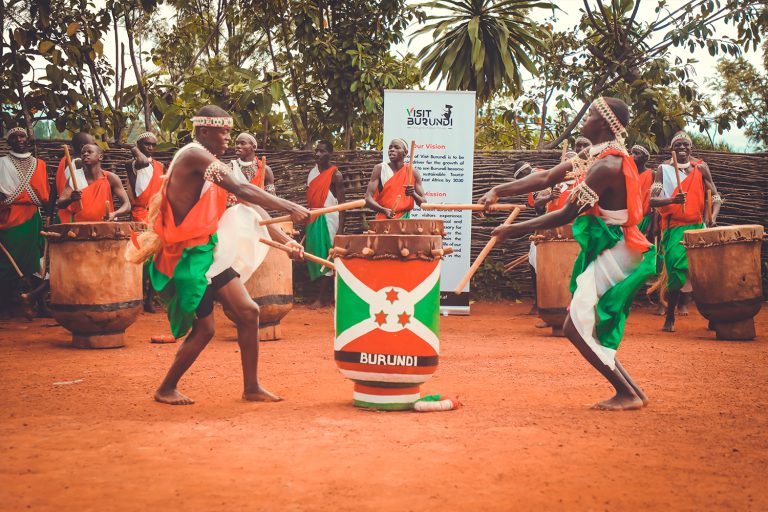
Burundi’s history reflects the strength of its ancient institutions, periods of external influence, and a long journey toward peace, unity, and national reconstruction. From a well-organized pre-colonial kingdom to a modern republic, the country’s past continues to shape its identity and future aspirations.
PRE-COLONIAL KINGDOM (16th Century – 1890)
The Kingdom of Burundi emerged in the 16th century and is traditionally associated with the founding figure Ntare Rushatsi. It developed into a centralized monarchy governed by a Mwami (king), supported by the Ganwa (royal princes), who played a key role in administration and mediation.
The kingdom was known for its strong social organization, agricultural foundations, and systems of solidarity such as ubugabire, which linked communities to royal authority through mutual obligations. During the reign of Ntare IV (1796–1850), the kingdom reached its greatest territorial expansion and institutional consolidation.
COLONIAL PERIOD (1890 – 1962)
At the end of the 19th century, Burundi came under German administration and was incorporated into German East Africa. Following the First World War, the territory was transferred to Belgium under a League of Nations mandate and later administered as part of Ruanda-Urundi.
Colonial rule introduced major political, social, and administrative transformations. Traditional governance structures were reshaped, and new systems were imposed, profoundly influencing Burundian society and its future development.
INDEPENDENCE AND STATE FORMATION (1962 – 1993)
Burundi achieved independence on 1 July 1962 as a constitutional monarchy. Prince Louis Rwagasore, a national hero and advocate of unity, played a central role in the independence movement.
In 1966, the monarchy was abolished and Burundi became a republic. The decades that followed were marked by political instability and repeated changes in governance, reflecting the broader post-independence challenges faced by many African states.
CIVIL CONFLICT AND PEACE PROCESS (1993 – 2005)
In 1993, Burundi entered a period of civil conflict following political instability. This prolonged crisis deeply affected the population, institutions, and economy.
The signing of the Arusha Peace and Reconciliation Agreement in 2000 marked a decisive turning point. The peace process led to a new constitutional order and power-sharing mechanisms designed to promote inclusion, stability, and lasting peace.
CONTEMPORARY BURUNDI (2005 – PRESENT)
Since the end of the conflict, Burundi has focused on rebuilding its institutions, strengthening national cohesion, and promoting economic and social development. In 2019, Gitega was officially designated as the political capital, reaffirming its historical and cultural significance.
Today, Burundi continues its path toward stability and development, guided by resilience, cultural heritage, and a commitment to peace, while engaging with regional and international partners.